
On Premises NOT On Premise KB ID 0001938
On Premises NOT On Premise: Problem
Every IT vendor brochure, LinkedIn post, and half the blogs on the internet keep talking about “on‑premise solutions”. Which would be fine, if that phrase actually meant anything. It doesn’t.
If you’re running servers in your own building, your own rack, your own broom cupboard, or your own nuclear‑hardened bunker, the correct term is on‑premises.
Explanation
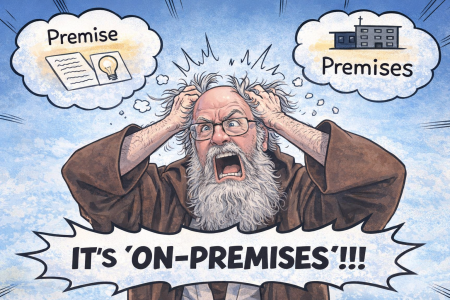
This all comes down to the difference between premise and premises. They look similar, but they’re not interchangeable.
-
Premise (singular): A statement or proposition used as the basis for an argument. “On the premise that the firewall is configured correctly…” (Spoiler: it isn’t.)
-
Premises (plural noun): A building or physical location. “The servers are located on the customer’s premises.”
So when you say “on‑premise”, what you’re literally saying is:
We run our infrastructure on an assumption.
Which, to be fair, describes some environments I’ve worked on! but it’s still not correct.
On Premises NOT On Premise: Why the Confusion?
Because in everyday speech, “premises” sounds like a plural of “premise”. It isn’t. English is a cruel and inconsistent language.
Add to that:
-
Marketing departments copying each other
-
American tech companies dropping syllables like they’re paid by the vowel
-
Engineers who’ve never seen the word written down
-
And the unstoppable force of LinkedIn influencers
…and suddenly “on‑premise” spreads like a misconfigured DHCP scope.
The Correct Usage
If it’s physically in your building, it’s on‑premises.
If it’s based on an assumption, it’s on a premise.
If it’s in Azure, AWS, or GCP, it’s cloud.
If it’s half in Azure and half in your server room because someone forgot to decommission the old SQL box, it’s hybrid (or “Friday afternoon architecture”).
Examples
Correct:
-
“We host our Active Directory on‑premises.”
-
“The backup appliance is located on the customer’s premises.”
Incorrect:
-
“We run Exchange on‑premise.” (No you don’t. You run it on‑premises, and you regret it daily.)
Correct but not what you meant:
-
“On the premise that the SAN won’t explode, we’ll proceed with the upgrade.” (This is a logical assumption, not a location.)
On Premises NOT On Premise: Why It Matters
Because language precision matters in technical documentation. Because customers read what you write. Because auditors read what you write. Because your future self will read what you write. And because if you’re charging enterprise rates, you should at least be able to describe where your servers physically are.
Related Articles, References, Credits, or External Links
Visit PeteNetLive on YouTube! (Please Subscribe)
